

The village of Kijiji-cha-Njaa held a wedding every five years, and every wedding was the same. They all called it “democracy.”
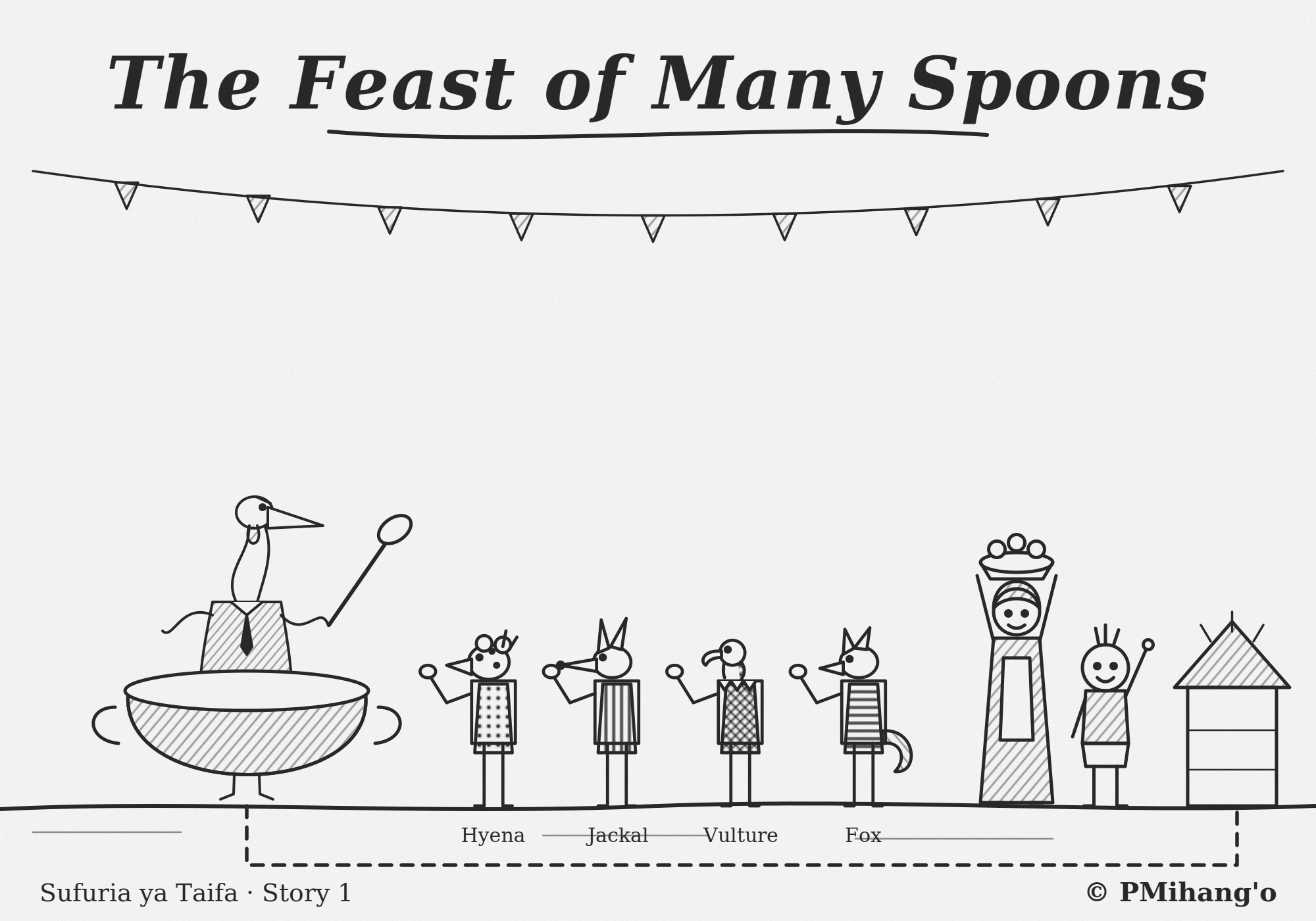
Before the feast, the village argued for months about who would be allowed to cook. This year there were four cooks, each with a different-coloured apron: yellow, green, orange and blue.
“The old cooks were thieves!” shouted the Yellow Hyena. “Vote for me, and the pot will be honest.”
“Nonsense!” cried the Green Jackal. “I will bring a new pot!”
The Orange Vulture promised a bigger spoon. The Blue Fox promised a smaller fire and a larger portion. The villagers argued themselves hoarse. They broke friendships over aprons and even wrestled in the market over colours. Mama Wanjiru sold her tomatoes quietly and watched.
Finally the day came, and the winner was a tall bird in a grey suit: Korongo the Marabou Stork. He walked to the pot with slow, solemn steps, like a man arriving at a funeral.
“My people,” he said, bowing his bald head, “I come from hunger. I know hunger. I was born under a leaking roof, and tonight we eat!”
The villagers roared. They had not eaten in two days, and they cheered the man who promised dinner.
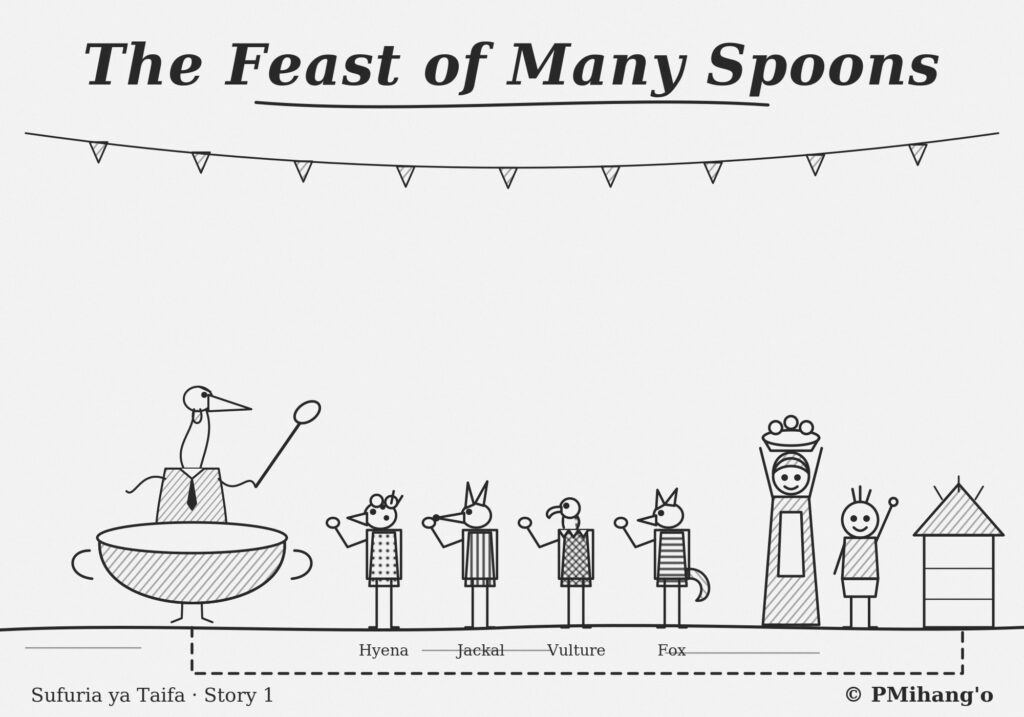
Korongo lifted the great Ladle and served. The first bowl went to the elders, and the second to the Hyena, the Jackal, the Vulture and the Fox, the losing cooks, whom he warmly called “my brothers in progress.” They ate beside him, still wearing their coloured aprons, and they chewed slowly, nodding.
“A government of national unity,” whispered the Fox, with ugali on his chin.
The villagers received what was left: a spoonful each, and a speech.
“Eat slowly,” said Korongo. “Good things take time.”
They clapped.
Wanjiru, standing at the back, noticed something odd. Each time the Stork bent over the pot to “taste for quality,” the level seemed to drop faster than the ladle could explain. She crept closer. The Stork’s long neck curved down, and then, behind the great pot, she saw it: a narrow, polished pipe running from the pot’s base, under the grass, toward a very large granary with a golden roof.
She tugged the Jackal’s sleeve. “Brother Jackal, you’re in opposition. Do you see that pipe?”
The Jackal looked at the pipe, then at his own full belly, and then, politely, at the sky.
“Which pipe?”
“The one under the grass.”
“Ah,” said the Jackal. “That pipe is a matter for the next election.”
She asked the Hyena, who said it was the Jackal’s job to check pipes. She asked the Vulture, who said pipes were a complex issue requiring a committee. She asked the Fox, who was already drafting that committee.
By evening the villagers were singing. Korongo stood on a tree stump and began to dance, a slow, stiff-legged, flapping dance that made everyone laugh. Children were lifted onto shoulders. A drummer produced a rhythm.
“Korongo is working! Korongo is working!” they sang, stomping on empty stomachs.
Behind them, quietly, the pipe hummed.
A small boy tugged his mother’s wrapper. “Mama, why is the pot getting empty if he’s working?”
“Hush,” she said, smiling brightly at the Stork. “He is working very hard.”
At midnight, when the drums stopped and the villagers slept hungry but happy, the Stork’s golden granary received its last delivery of the evening. The Yellow Hyena, the Green Jackal, the Orange Vulture and the Blue Fox gathered at its door, still wearing their coloured aprons.
“Same time next year?” said Korongo, wiping his beak.
“Of course,” they said. “We’ll shout at you again before the next feast.”
“Wonderful. Shout loudly. It reassures them.”
They shook hands. In the dark, their aprons looked almost the same colour.
Far away at her stall, Wanjiru counted tomorrow’s tomatoes by lamplight. She counted them twice, then a third time. The pipe, she thought, had been carefully built, which meant someone had planned it for a long time.
On the wall behind her, her little son had drawn a picture in charcoal: a great pot, a stork, and a long line underneath, leading to a golden roof.
“Mama,” he said sleepily, “why does everyone clap?”
She looked at the drawing for a long moment.
“Because,” she said at last, “they haven’t yet learned to count.”