
When the laughter reached the granary, the Marabou Stork called an emergency meeting of everyone who had ever eaten from his plate.
They arrived in black cars: the Cormorant, the Tortoises, the Jackals in dark glasses, the Warthog with the waistcoat, and the Hyena’s cousin, who had been promoted to the Hyena’s chair. The Stork stood in front of them holding what remained of his Handbook for Staying. Four chapters were missing. One had a goat’s tooth marks on it.
“Gentlemen,” he said gravely, “the Cubs are counting.”
“Counting what?” asked the Warthog.
“Everything.”
There was a long silence, which is the sound of a room full of people doing arithmetic about themselves.
“Then we shall do what the Handbook says,” said the Cormorant, polishing his calculator. “Chapter Two. Switch off the lights.”
That night the whole village went dark. The streetlamps went out, the market lamps went out, and the Parrot Broadcasting Corporation announced that the darkness was “a temporary national rest.”
By eight o’clock the village was black as the inside of a pocket.
By nine, a single light appeared on the hill. It was a candle in a clay jar, held by a small boy.
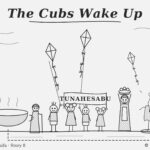
By ten there were a hundred, and by midnight the whole village was lit like a wedding. The Cubs had made lanterns from tin cans and kites from paper, and every house had remembered where it kept its candle. Cucu stood in her doorway holding the old radio like a torch.
“Usiku wa giza, nyota huangaza,” she said. In a dark night, the stars shine. “It seems that nobody told them the lights were theirs.”
The Stork looked out of his window at a village glowing in defiance, and turned to Chapter Three.
“Call them foreign agents.”
The next morning the Parrots screamed it from every loudspeaker: “THE CUBS ARE FOREIGN! THE CUBS ARE PAID BY THE NORTH WIND!”
The Cubs read the announcement carefully. The boy put up his hand.
“Excuse me,” he said. “I was born here, and so was my mother. My grandmother was born here, and she says her grandmother was born under that tree.”
“The tree is foreign,” said a Parrot weakly.
“It’s an acacia,” said Njeri.
A reporter-parrot took notes, looked up at the tree, looked down at his notes and quietly crossed out the word. He then flew away and was not seen on the evening broadcast. In his place appeared a new Parrot who had been trained not to look at trees.
Chapter Four was the one the Stork had hoped to avoid. It was called “Reduce the Population of Awkward People,” and it was the page where the goat’s tooth marks were deepest.
That night the Jackals in dark glasses went door to door. They did not knock. They had a policy about knocking. They took Njeri from her mother’s doorstep in the dark and drove her to the Guest House, where the walls were painted yellow, the windows had flowers and the rug at the entrance had a laugh in it.
In the morning the village woke up and Njeri was gone.
Nobody spoke. It was the old silence, the Iron Season silence, rolling back across the hill like a cold fog. Mothers pulled their children indoors. The Clapping group began, softly, to sing “Korongo is working.” Wanjiru stood in her doorway holding her son’s hand so tightly his fingers went white.
“Mama,” he whispered, “are they going to take us too?”
She did not answer. She looked at the hill, at the dark windows, at the great golden roof gleaming in the sun, and she knew that this was the moment the whole fable turned on. Either the fog rolled all the way down, or somebody lit a candle.
She went inside and came out with a candle.
She walked to the Guest House alone, in daylight, in her good headscarf, carrying her basket of tomatoes, and she stood at the yellow gate and said, in a very ordinary voice, “Good morning. I’d like to buy my neighbour’s daughter back.”
“We don’t sell people,” said the Jackal at the gate.
“Then why do you keep a receipt book?” said Wanjiru.
He looked down. He had, in fact, been holding a receipt book.
Behind her, one by one, other people had begun to arrive. Cucu, leaning on her stick. The tomato sellers. The hustlers with their certificates. Mothers, uncles, aunties and the Warthog’s own wife, who had come to buy her neighbour’s daughter back and had accidentally brought the whole street. By noon there were three hundred villagers standing at the yellow gate, not shouting, not throwing anything, just standing there. Every one of them was holding something: a candle, a tomato, a spoon.
The Jackal in dark glasses took his dark glasses off. His eyes were smaller than he had thought, and so was his courage.
“Is it true,” asked an old man in the crowd gently, “that you were paid for this?”
“Not very much,” said the Jackal.
“How much?”
He named a sum. There was a gasp. It was the price of three tomatoes.
“You’ve done this,” said Cucu, tapping her stick, “for three tomatoes?”
The gate opened at four o’clock. Njeri walked out blinking, with a chalk-stained hand holding a piece of yellow paint she had scraped from the wall.
“They had no books,” she told the boy, with deep contempt. “Just forms.”
That evening the Stork tried his last page of the Handbook, the final instruction, the one in capital letters.
“IF ALL ELSE FAILS, DANCE.”
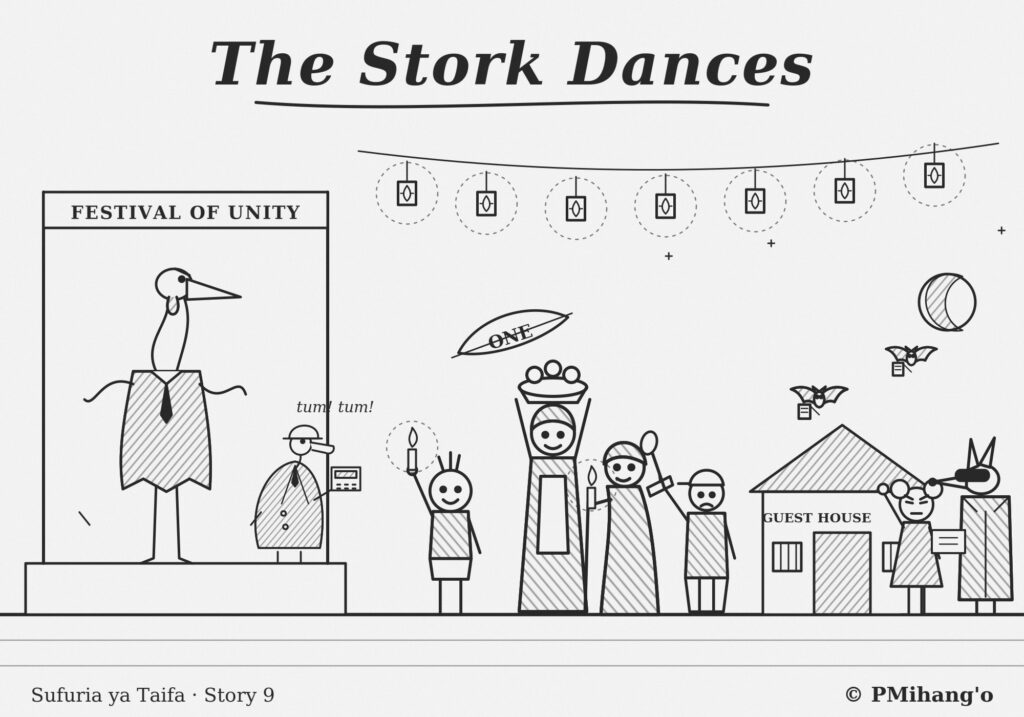
He called a Festival of National Unity in the village square, with drums, flags and a compulsory attendance list. He stepped onto the platform in his best suit and danced the slow, stiff-legged, flapping dance that had once brought the village to its feet.
The crowd stood, and the drums played. Nobody clapped.
He danced harder, and the Cormorant played the drum himself, badly. The Warthogs shouted “Korongo is working!” with all the enthusiasm of men reading a bus timetable. The Stork’s knees creaked, his tie flapped, and a single feather came loose and drifted down into the silent crowd.
The boy picked it up, solemnly, and wrote on it with a charcoal stub.
Then he held it up to the sky, as high as his arm would go, and the whole village saw what he had written.
ONE.
And in the quiet, from somewhere at the back, the old mother who sold bananas said, clearly, “Two.”