
A year later, Wanjiru’s son was older, taller and slightly embarrassed to be asked about his famous pencil.
The village had changed, in small ways that are hard to see from far away. The Guest House had a new sign over the door and was now The Library of Forgotten Things, with a very big rug inside, which had been taken down, washed, mended and quietly given a respectful burial in the village cemetery, under a stone that read Here lies a laugh. The Great School on the hill had a new motto above the gate, painted by the children themselves: Uliza. Ask.
Mwalimu Bundi still taught there. He had been persuaded, with some difficulty, to take the chant down from the blackboard. He now taught a lesson called “Why?” and it was the most popular class in the school. On the first day, he had given every child a gold star simply for raising a hand.
The road to nowhere had been dug up, measured and rebuilt by a very small company owned by the hustlers, who knew exactly how long it should be. It was eleven kilometres, and it went to the sea.
And the pipe, the long, polished, shameful pipe, had been dug up, scrubbed and reconnected to the pot. It now ran the other way. It carried water from the hills, and it watered every tomato patch in the village. Wanjiru’s tomatoes had never been so red.
The Ladle was the best change.
It no longer lived in anyone’s hand. After the election, the village had hung it on a hook in the centre of the square, under the big acacia tree, where everyone could see it. Whoever needed to serve took it down, served in front of the whole village, and hung it back up. The job rotated every season, and the person serving wore a sash that said FOR NOW.
“It sounds humiliating,” said the Warthog, who had been given a turn in his first year.
“It is,” said Cucu. “That is why it works.”
The pot, too, had been rebuilt. One side of it was now made of clear glass, so that anyone could look in and see how much was left. The villagers called it the honest side. On a busy day, there were queues of children looking into the pot and calling out the level to each other like sailors reading a tide.
“Nusu!” Half.
“Robo tatu!” Three-quarters.
“Tele!” Full!
And there was a new tradition, which nobody had planned. Once a year, on the night of the first count, every household brought one grain of maize to the square and laid it on the long table beside the Book of Forgotten Things. They did not count it. They just laid it there, and looked at it, and remembered.
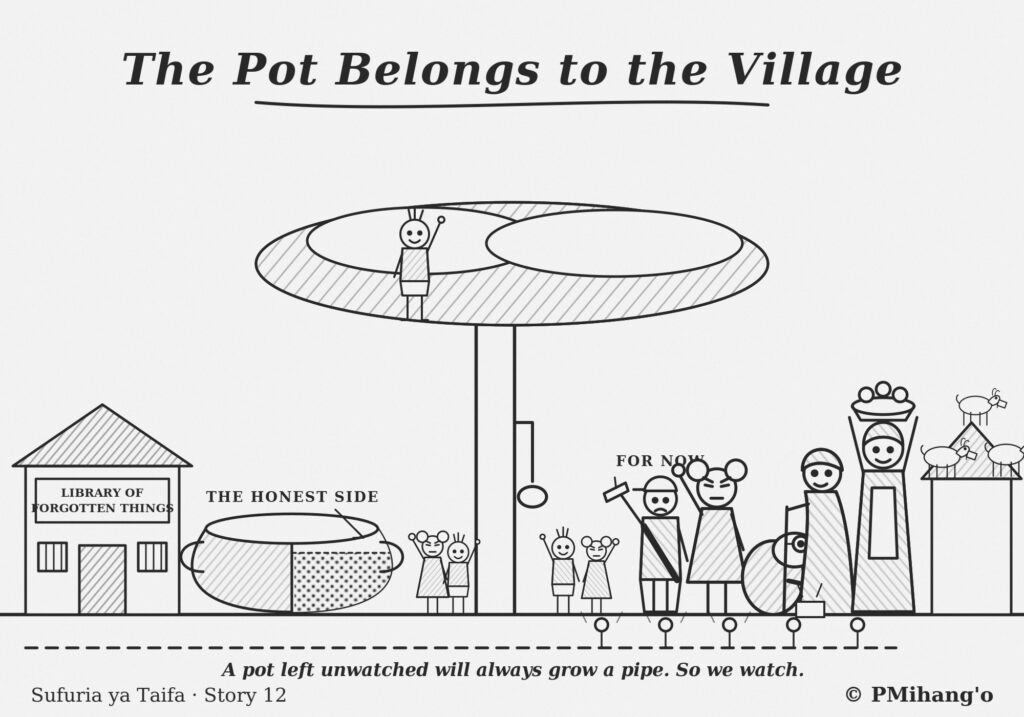
Late in the evening, on the anniversary, the boy climbed the acacia tree with a stub of charcoal and a slate.
Below him, a hundred small children were sitting cross-legged in a ring, with their own tiny chalk boards, waiting to be taught. Njeri, now a teacher, stood among them in a clean dress, her two puffs of hair as fierce as ever. Fuko the mole sat on a stool beside her, in his spectacles, with a notebook. Cucu sat in a chair at the front with her radio on her lap, humming along to a song that came from the north.
The boy looked down at his audience.
“Who can tell me,” he said, “how a pot gets a hole?”
A hundred hands went up.
“Because someone stopped watching it,” said a small girl in the front row.
“And who stops watching it?”
“People who are tired,” said another.
“People who are grateful,” said a third, very solemnly, and everyone laughed, because they had all heard the story.
“And what do we do about it?”
The whole ring answered together, a hundred small voices, in the singsong rhythm of children who have learned something by heart and understood it.
“We count! We write it down! We don’t clap until we’ve counted!”
He smiled, and for a moment he looked exactly like his mother.
Wanjiru, standing at the back with her basket on her head, saw the smile and had to look away at the hills. She had a speech prepared. She had been preparing it for years. But when she opened her mouth, she found that the only thing she wanted to say was the simplest thing in the world.
“Hesabu,” she called gently across the square. Count.
“Moja,” said the children. One.
“Mbili.” Two.
“Tatu.” Three.
The sound rose into the dusk like a flock of birds. It rolled across the pot, over the library, past the old golden roof, which had been turned into a school roof and now held a hundred sleeping goats, and out across the hills, to the villages beyond them, where windows were beginning, one by one, to open.
On the glass side of the pot, in the last of the sunlight, someone had scratched a final line with a nail. It was small, and most people never noticed it, but the children who found it always read it aloud.
“A pot left unwatched will always grow a pipe.”
And under it, in the boy’s neat handwriting:
“So we watch.”
The End.