
The village decided to hold an election, and for the first time in its history, it decided to hold it properly.
Rule One was Wanjiru’s: “Nobody votes on an empty stomach, and nobody votes on a full one that was filled by a candidate.”
Rule Two was Cucu’s: “Whoever watches the jar, watches the count.”
Rule Three was the boy’s, and it was very short: “Write it down.”
The system was ancient and simple. Each candidate had a jar. Each villager had one grain of maize, which they dropped into the jar of their choice. At the end of the day, the grains were counted aloud, in public, in daylight, by anyone who wanted to count. Everyone wanted to.
The candidates came forward.
The Yellow Hyena was first, in a new apron. It was still yellow, but now it had a small picture of a dove on it.
“My friends!” he cried. “I have changed! I used to be in the old government, but now I am against the old government. I have been against it since last Tuesday!”
“What about the pipe?” asked Wanjiru.
“I have always been against pipes,” said the Hyena. “My own cousin built one, but I was very cross with him.”
The Green Jackal came next, with a new pot on a cart.
“I will bring a new pot!” he cried. “A bigger pot, a shinier pot, a pot with a golden lid!”
“Where will the old pot go?” asked the boy.
“We will keep it,” said the Jackal quickly. “For the pipe.”
The Orange Vulture promised a bigger spoon, the Blue Fox promised a smaller fire and a larger portion, and the Warthog, in a waistcoat that had been quietly let out, promised that if elected he would “continue the work already begun, except for the work that went badly.”
Each candidate offered gifts. There were free mandazi, free spoons, free t-shirts and free hats, and a very large goat.
The village accepted every gift with great politeness, ate every mandazi, wore every t-shirt, and quietly kept the goat.
“And now,” said Wanjiru, “who are you voting for?”
The village looked at her.
“Our grain,” said everyone, “is our own.”
On the morning of the election, the Cormorant arrived at the square with his calculator under his wing.
“I’m here to assist,” he said brightly. “I have developed a system. It is called the Electronic Counting Machine. You simply put the grains in at one end, and the result comes out at the other.”
“What happens in the middle?” asked Fuko the mole.
“It is confidential,” said the Cormorant.
Njeri took the calculator and shook it. It rattled. She opened the back, and out fell a small slip of paper which read, in the Cormorant’s own handwriting: “Add 400 to the Warthog.”
“Ah,” said the Cormorant. “That is a test message.”
The Parrots arrived next, at nine o’clock, to announce the winner.
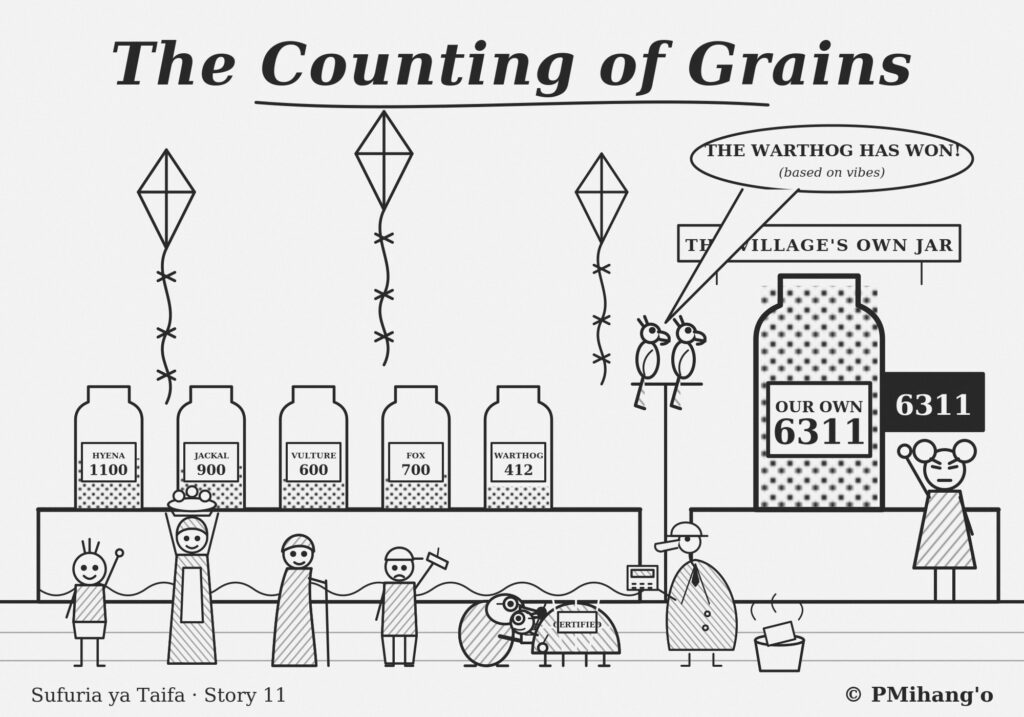
“THE WARTHOG HAS WON!” they cried, from every loudspeaker.
“Excuse me,” said the boy. “It is nine in the morning. We haven’t started.”
“It was a projection,” said a Parrot.
“Based on what?”
The Parrot paused. “On vibes.”
The Tortoises arrived, with a stamp.
“We have certified the result,” said the chief Tortoise. “In advance. To save time.”
“You haven’t seen the result.”
“We are very experienced,” said the Tortoise.
And so, under a tree, with the sun climbing slowly and the whole village watching, the real count began.
It was a beautiful thing, the Counting of Grains.
There was a jar for every candidate, standing in a row on a long table. Beside each jar sat a pair of watchers, one from the village and one from the candidate, who were not allowed to blink at the same time. The villagers dropped their grains in, one by one, each with a little ceremony. Some held the grain up to the light first. Some kissed it. One old man dropped his in a jar and then asked to take it back, and was told gently that this was not how it worked.
At four o’clock the voting ended. The jars were emptied, one by one, onto white cloths, and counted aloud in rows of ten. The Cubs held up chalk boards. Fuko checked the arithmetic. The boy recorded every row in his book. The kites, all of them, flew over the square with the running totals written on their tails.
“Kumi! Ishirini! Thelathini!” the crowd chanted. Ten, twenty, thirty.
It took four hours. It took ten thousand grains. At every count, the whole village held its breath, and every time someone tried to hurry the process, a hundred voices said, in a gentle chorus, “Slowly. We’re counting.”
The Cormorant’s calculator, brought out for a “second opinion,” was politely placed in a bucket of water.
At eight o’clock in the evening, under the lamps, the last row was counted. Njeri stood on a stool with the final chalk board, and she did not need a microphone. She did not even need to shout. The village was so quiet that you could hear the ladle hanging on its hook.
“Hyena,” she read. “Eleven hundred.”
“Jackal. Nine hundred.”
“Vulture. Six hundred. Fox. Seven hundred. Warthog. Four hundred and twelve.”
There was a pause. Njeri turned to the last jar, the biggest one, which stood by itself at the end of the table. It had no apron, no name and no slogan. On its side, in chalk, the Cubs had written four words.
THE VILLAGE’S OWN JAR.
She held up the final board, and her hand shook only a little.
“Six thousand, three hundred and eleven.”
For a moment nobody moved.
Then the old woman who sold bananas began to laugh. It was a cracked, surprised, joyful laugh, the kind that sounds like a door opening in a house that has been shut for forty years. The laughter spread to the tomato sellers, to the hustlers, to the mothers and uncles and aunties, until the whole square was roaring, hugging, crying, and banging spoons on pots again, though this time they were full.
“Is it legal?” asked the Warthog faintly, sitting on the ground.
“It’s counted,” said Wanjiru.
Cucu leaned on her stick and looked up at the stars, and quietly, so that only the boy could hear, she said, “You see? Hawakuwa wamejifunza kuhesabu. They hadn’t learned to count.”
“And now?” asked the boy.
“Now,” said Cucu, “they can’t be stopped.”