
It started with a sneeze.
A small one, in the schoolyard, in the middle of the morning chant. “One: the Pot is full. Two: the Ladle is kind. Three…” and then a boy at the back went “Aaa-choo!” and, as the whole class turned to stare, said clearly, to nobody in particular:
“Excuse me. I think the pot is not full.”
There was a silence so deep you could hear the chalk think.
Mwalimu Bundi, the owl, slowly rotated his head three-quarters of the way round. “Who said that?”
Nobody answered. But in the back row, Njeri was looking at the boy with an expression of pure, joyful violence, and beside her another child quietly stopped chanting. Then another. By the end of the first verse there was a hole in the chorus, and the owl, who had taught that chant for thirty years, discovered for the first time that it sounded like a lie when it was sung slowly.
“Silence!” hooted the owl. “That is not in the syllabus!”
“Then,” said Njeri, standing up, “the syllabus is the problem.”
By afternoon the whole school had walked out.
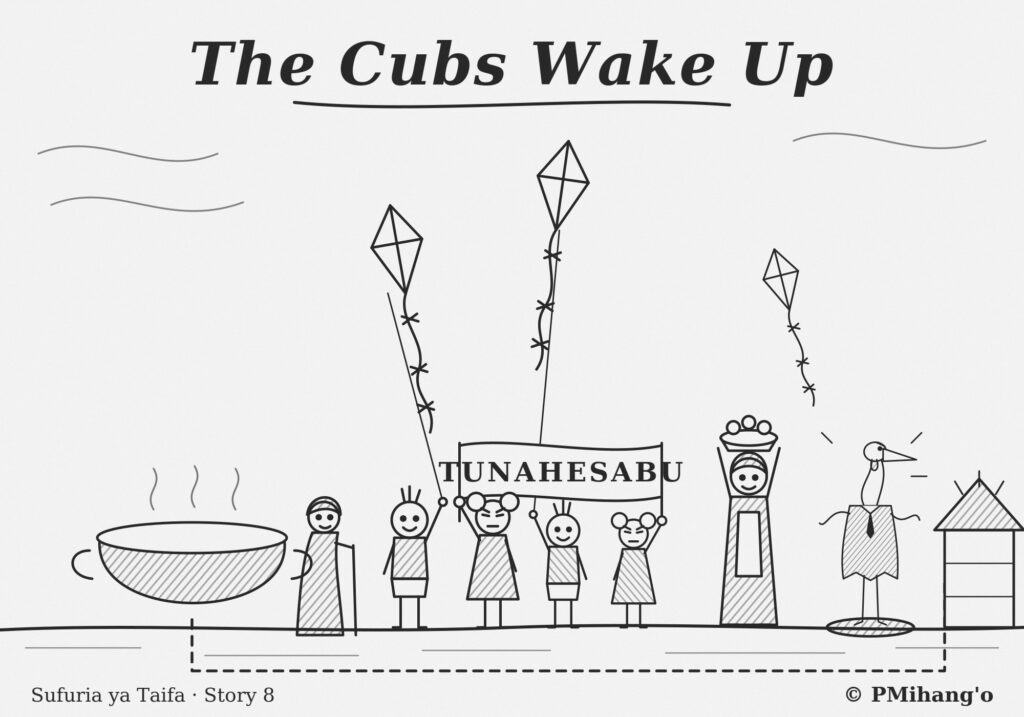
They came out of the blue gate in a long, untidy line: the Cubs, the Watoto wa Mchana, children and teenagers with ink on their fingers, torn uniforms and bare feet, carrying kites and slates and one very large pot lid which a girl was beating like a drum. They did not have a plan. They did not have a leader. What they had was The Book of Forgotten Things, which Njeri held above her head with both hands, like a priest with a holy book that was also a very rude joke.
They walked to the pot, and they began to count.
“Moja!” shouted the boy, pointing at the pipe. One.
“Mbili!” shouted Njeri, pointing at the tap on the old Pelican nozzle. Two.
“Tatu!” cried a small girl, pointing at the plug in the base of the pot. Three.
“Nne! Tano! Sita!” The crowd of Cubs was growing, spilling out of the schoolyard and into the market, counting the road, the bridge, the river that was a ditch. They counted the Hyena’s rug and the Stork’s two-shoes cousin and the Jackals in dark glasses at every corner. They counted the Dragon’s debt, which, when they added it up on the school wall in chalk, was a number so large that two of them sat down in the dust and had to be fanned.
“Is that ours?” asked a girl.
“It’s yours,” said Njeri. “It’s all ours. Somebody just signed for us before we were born.”
Then, as happens in the best revolutions, the grown-ups arrived and made it worse.
A delegation of Uncles came running up the hill in their Sunday suits, out of breath and furious. “Children!” they panted. “Go home! You are disrespecting your elders!”
“We’re counting,” said the boy.
“You’re shouting!”
“Yes. In sequence.”
“The Stork is a father to this village!” cried the biggest Uncle, a plump Warthog in a waistcoat who had been given a cousin’s job in the Ministry of Pipes. “He has done so much for you!”
“Like what?” asked a Cub.
The Warthog opened his mouth. “He has… looked after the pot.”
“Where is it?”
“It’s right—” He pointed. The Cubs looked. The pot was there, huge and dignified, with a small queue of ants walking out of the plug.
“We don’t have time for this,” said the Warthog, and fled, trailing a rug.
An Auntie came next, wringing her headscarf. “My child, they will come for you. They will bring the Jackals. They will switch off the lights!”
“Let them,” said Njeri gently. “We have kites.”
The Auntie looked up. Dozens of paper kites were rising over the village, rattling in the north wind, each with a long tail of scraps, and on each scrap, in small black handwriting, was one thing from the Book. The whole sky was a list. A thousand lines of evidence, flying in plain view.
“Eh,” said the Auntie softly. She put down her scarf. “That one on the left. Is that my husband’s pipe?”
“It might be,” said Njeri.
“Give me a string,” said the Auntie.
By evening, the village had divided into three groups.
The first group was the Terrified, who hid indoors and shouted advice through the shutters. The second was the Clapping, who stood outside the Stork’s gate singing “Korongo is working!” a little too loudly, looking around for approval. And the third was the Counting, who sat on the ground at the foot of the pot with chalk, string and the Book, and added things up.
The Cubs did not riot. Mwalimu Bundi, watching from the school steps, noticed it with a kind of horrified admiration. They did not smash, burn or steal. They did something far worse: they asked questions, in a calm, cheerful, endless, cheerful chorus.
“Where did the road go?”
“Where did the grain go?”
“Where did the Hyena go?”
“WHY DID NOBODY TELL US?”
Cucu, in her best headscarf, her good shawl and her second-best stick, walked up to the front of the crowd. She did not speak. She simply took out the old radio, held it up to the sky and turned it on at full volume, for the first time in eleven years.
The voice of the Cubs of the Village of Sands crackled out over the pot, over the market, over the golden roof, as clear as a bell.
“…we hear you. Over there, we hear you! Is that Kijiji-cha-Njaa? Over!”
The whole crowd roared. Cucu laughed, a wicked, wheezing, delighted laugh, and wiped her eyes with the corner of the kitenge.
“Child,” she said to Wanjiru, who had come to stand beside her, “do you know what the old people say about a pot that boils too long?”
“No, Cucu.”
“It lifts the lid.”
Far up the hill, behind a locked gate, the Marabou Stork stood at his window, watching a thousand kites climb over his granary and a thousand small voices count his sins in rhythm.
He had a drink in one wing and the Handbook for Staying in the other. The Handbook was missing four chapters, thanks to the goat, and the margins were covered in his own panicked notes. He turned to the last page and read the single instruction at the bottom.
“If all else fails, dance.”
He put down the drink. He straightened his tie. He cleared his throat, and stepped onto the balcony to address his people.
And so, with the whole village watching, the Stork began his famous slow, stiff-legged, flapping dance, wings spread, knees bent, beak raised in solemn triumph.
For a moment, the crowd was silent. Somewhere a child giggled. Somewhere an old man coughed. Somewhere a goat chewed.
Then the boy said, in a small, clear voice, “He’s doing it wrong.”
“What?” whispered Njeri.
“The dance. He used to look like a man being welcomed. Now he looks like a man trying to leave.”
And all over the hill, quietly at first and then in a rising wave, the Cubs of Kijiji-cha-Njaa began to laugh.
It was not an angry laugh. It was worse. It was the laugh of a child who has noticed that the emperor is wearing a very ordinary tie.
The Stork danced faster. The Cubs laughed harder. The dance became frantic, wings flapping, knees knocking, beak snapping, and the louder they laughed, the more desperate he looked, until at last he stopped, panting, in the middle of the balcony, and stood there with his arms hanging, a very tall, very tired bird in a very good suit, watching the sky fill with kites.
For the first time in his life, nobody clapped.