
The idea came, as the best ones do, from a very hungry child.
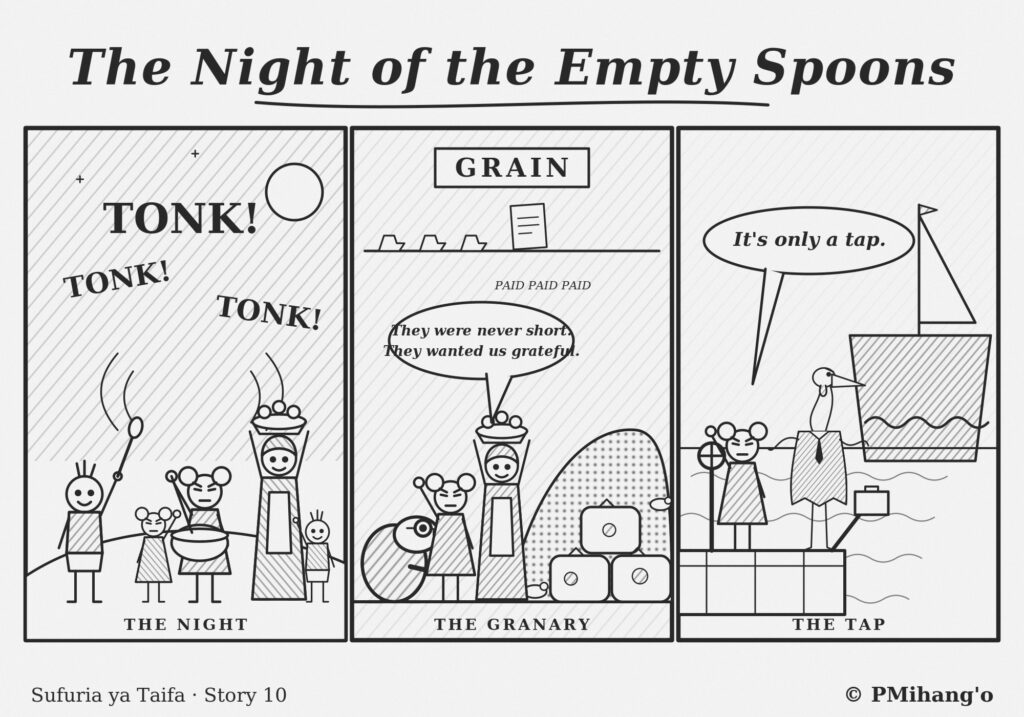
It was a small girl at the back of the Counting, and she had been told to be quiet for so long that she had run out of patience. She picked up her empty wooden spoon and an old tin cup and began to bang them together. Tonk. Tonk. Tonk.
“Why are you doing that?” asked her brother.
“Because it’s empty,” she said.
Nobody could argue with that. So that night, at dusk, a hundred children went to the hill with their empty spoons and their empty cups and began to bang. Then their mothers joined them with ladles and lids, and the fathers came with pots and pans, and the grandmothers brought the big drums that hadn’t been used since the last wedding. It began as a ripple and became a roll, and by midnight the whole village was making a noise like a thousand hungry stomachs arguing.
The hustlers brought their empty bottles. The Tortoises’ own cooks, secretly, brought their own pans. Cucu brought her bean pot, with the radio inside it turned up to full volume.
They called it The Night of the Empty Spoons, and it went on until dawn.
In the golden granary, the Stork lay awake with a pillow over his head.
“Tonk. Tonk. Tonk.”
“Cormorant!” he shouted. “Make it stop!”
The Cormorant, who had been sitting up with his calculator, looked haggard. “I have calculated the noise,” he said weakly. “It is eleven thousand decibels. The calculator says that it is impossible.”
“Then why can I hear it?”
“I don’t know. It is outside my budget.”
At two in the morning the Stork sent for the Tortoises. They arrived at four, slowly, in a cart pulled by their own assistants.
“We recommend,” said the chief Tortoise, “a Commission.”
“A what?”
“A Commission of Inquiry into the Noise. It will sit for two years.”
The noise had been going for six hours. A small child on the hill, hearing this, laughed so hard that she dropped her spoon. Then she picked it up and began again.
At dawn, a strange thing happened. The noise stopped, all at once, as if a conductor had dropped his arm, and the silence was so complete that you could hear a bird clear its throat.
From the village square, a very small voice, a mole’s, called out through the morning mist.
“I have a map.”
It was Fuko, standing on a crate for the second time in his life, holding up The Book of Forgotten Things. In the back, in his tiny, careful handwriting, was a map of every tunnel under the village, with the pipe marked in red.
“It starts at the pot,” he said. “It goes under the school, under the road, under the bridge and around the Guest House. It ends at the granary. I have measurements.”
The village followed him. It was not a mob. It was a procession of mothers and children and grandfathers, holding spoons and walking quietly in the dawn, and at the front, holding the map, walked a small, short-sighted mole. They reached the golden gate, and the Jackals in dark glasses looked at the crowd and quietly opened it.
“I was told to guard it,” whispered the nearest Jackal. “But nobody told me from whom.”
Inside, there was a hall. And in the hall, there were rooms, and the first room was full of paper, thousands and thousands of receipts, every one stamped PAID. The second room held shoes: hundreds of left shoes, in perfect pairs, and the village stared at them for a long while without speaking. The third was a ballroom with a mirror on every wall, and the Stork’s golden dancing shoes in the middle of the floor.
At the very back stood a door that said GRAIN.
Njeri pushed it open.
It was full to the roof. Sacks of grain, mountains of grain, a fortune in grain, and the whole room smelled of sweet, rotting flour. It had been sitting there for years, while the village went hungry. Half of it had gone black, and mice had held weddings in it.
“They were never short of grain,” said Wanjiru slowly. “They only wanted us grateful.”
Nobody shouted. Nobody threw a stone. A hundred villagers stood in the doorway of the granary with their empty spoons in their hands, looking at a mountain of spoiled food, and the silence was heavier than any noise they had ever made.
Then the boy said, quite calmly, “Let’s open the doors and give it out.”
They did. By noon every house in Kijiji-cha-Njaa had a sack, and every sack had a name written on it in chalk.
The Stork was found at the harbour, in his best suit, trying to board a ship.
It was a ship the village recognised. It was low in the water, with a lamp at the mast and a faint smell of jasmine in the air.
“Where are you going?” asked Cucu, leaning on her stick.
“To rest,” said the Stork with dignity. “I have worked very hard.”
“The ship is already full,” said the sailor-pelican at the gangway. “It has been taking people like you for years.”
The Stork turned to the crowd, and for the first time he had no speech.
“People of Kijiji-cha-Njaa,” he began, “I loved you.”
“You loved the pipe,” said Njeri.
He opened his beak. He closed it again.
Behind him, with a hiss and a gurgle, the ship’s hull gave a slow shudder, and the pipe that ran under the harbour, the old one, the first one, the one from Madam Pelican, rattled like a snake in a drainpipe. Njeri walked across the dock, put her hand on the little painted tap at the harbour end, and turned it.
It took surprisingly little effort. It was only a tap.
The ship rose in the water, an inch at a time, like a creature sighing with relief.