
The winds began to change in the dry season.
First there was a rumour, carried by a swallow that landed on Wanjiru’s stall, panting, with a feather missing. “In the Village of Sands,” she gasped, “up north, the Cubs have chased the Old Lion off his chair!”
“What did he do?” asked Wanjiru, handing her water.
“He fell off it,” said the swallow. “He had been sitting there so long that he had grown into the cushion.”
News in that country travelled in waves, and the waves always came from the north. They were not always the same. Long ago there had been the Wave of Flags, when villages across the whole land threw off their Pelicans one after another, like a row of dominoes learning to sing. Then came the Wave of Boots, when soldier-crocodiles climbed out of the river in village after village and took the chair “temporarily,” which in crocodile means forever. After that came the Wave of Many Spoons, which the Stork knew very well, because it was the one that had brought him his job.
Now there was a new wave, and the Stork could feel it in his feathers.
He did what any wise leader does when frightened. He called a conference.
The Annual Summit of Marabous, Lions and Other Persons of Distinction was held in a grand hotel on the coast, with chandeliers, a buffet longer than a bus and a banner that read “UNITY, STABILITY AND SECOND HELPINGS.” Leaders arrived from every corner of the continent in long black cars. They kissed each other on both cheeks and then checked their pockets.
On the first morning, the Lion of the Dry Plains took the microphone.
“My friends,” he rumbled, “I have been in power for forty years. People ask me my secret. It is simple: I changed the calendar. Every time my term ended, I declared that it was only a warm-up.”
The room applauded.
A tall Heron from the western lakes stood next. “I solved the youth problem,” she said smoothly. “I told them they were the leaders of tomorrow, and then I made sure tomorrow never came.”
More applause. Someone fainted from admiration.
A Crocodile in dark glasses spoke last, in a very low voice. “When the Cubs get loud, there is only one rule. Switch off the lights.” He tapped the side of his head. “If they cannot see each other, they cannot gather. If they cannot gather, they cannot sing.”
The Stork wrote this down carefully in a small gold notebook, underlining the last sentence twice.
“And if they sing anyway?” he asked.
“Then you tell the world they are foreign agents,” said the Crocodile, “and you blame the rain.”
All the leaders nodded. It was the oldest trick in the book, and every chapter of the book was in the same handwriting.
“Ukiona vyaelea, vimeundwa,” a waiter murmured to himself, refilling a glass. When you see things afloat, someone built them. He was dismissed that afternoon for “an attitude.”
The Stork returned from the summit in a very good mood. He had a new notebook, a new suit and a very thick folder labelled HANDBOOK FOR STAYING, and for the first time in months he danced his slow, stiff-legged dance at the edge of the pot.
He also made some changes.
He put a lock on the village loudspeaker and a very large padlock on the Parrot Broadcasting Corporation’s door. He appointed a Minister of Calm and a Department of Positive Thinking, which issued daily instructions for how to feel. He announced that the north wind was “a foreign breeze” and ordered everyone to keep their windows shut, “for health reasons.”
The village obeyed, and for a few days the air in every house was warm and stale and smelled of old socks.
Then the Cubs began to cough.
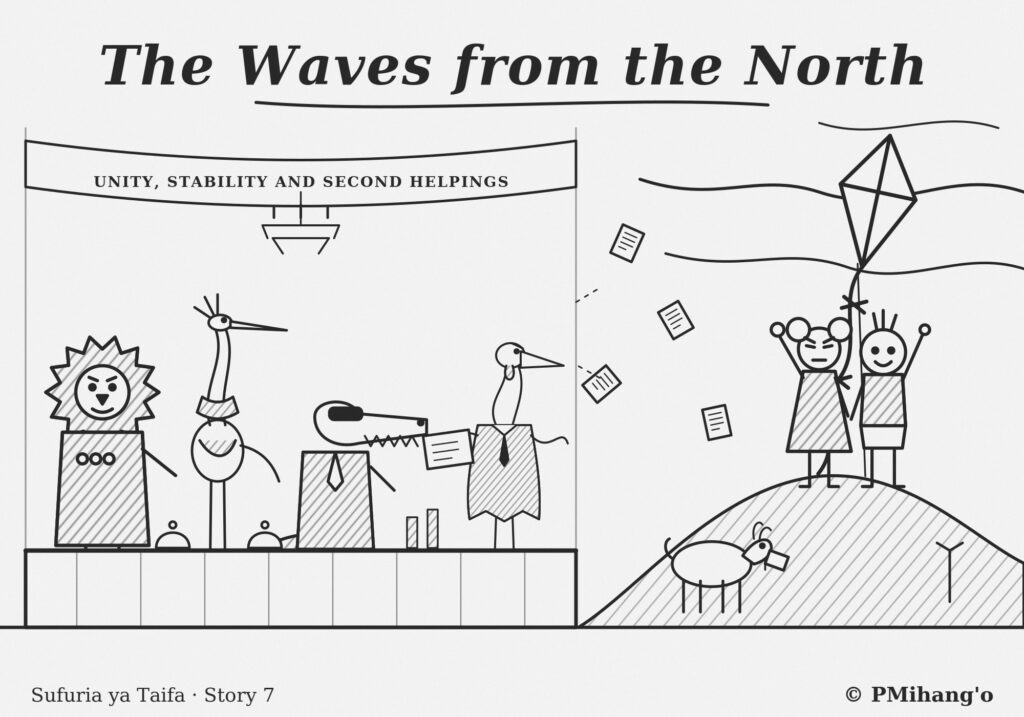
That evening Wanjiru’s son and Njeri were at the top of the hill, flying a kite.
It was a poor kite, made of old newspaper, two sticks and a string unpicked from a flour sack, but it had a long tail of scraps, and on each scrap they had written something small. The pipe. The tap. The hole in the pot. The road. Every item from The Book of Forgotten Things.
For weeks the kite had barely left the ground. The air over Kijiji-cha-Njaa had been heavy and still, like a held breath.
But tonight something changed. The wind rose, from the north, strong and cool and smelling of sand and distant rain, and the kite jerked in the boy’s hands like a living thing.
“Hold it!” shouted Njeri.
“I’m holding it!”
“Hold it harder!”
The kite went up. It rose past the tops of the trees, past the Stork’s golden roof, past the hill, and it kept rising, tail streaming, dragging its small cargo of memories into the dark. All over the village, windows began to creak open. People looked out and saw a scrap of newspaper, high above the Stork’s compound, dancing in the north wind.
Down in the pot, the bean-pot radio crackled in Cucu’s kitchen. Faintly at first, then louder, a voice came through the static, young and unsteady and very much alive, from the hills beyond the hills.
“…we are the Cubs of the Village of Sands. We are not afraid. Is anybody listening? Does anybody out there hear us? Over.”
Cucu, who had not smiled in eleven years, put down her beans.
“Wanjiru,” she said slowly. “Fetch me my good headscarf.”
“Why?”
“Because I’d like to be dressed,” said Cucu, “when it begins.”
At dawn, a delegation of exhausted officials arrived at the Stork’s gate with some bad news. The north wind had been too strong, and it had blown the Handbook for Staying clean out of the Stork’s window and across the whole village. The pages were everywhere. They stuck to fences and fluttered down the road, and a goat was seen chewing Chapter Four.
“Ha!” said the Cormorant. “Switch off the lights, he says! Is that not clever?” He stooped, read a page and went pale. “Oh dear. Someone’s underlined it.”
All through the market that morning, villagers were picking up the pages, squinting at them and reading them aloud to each other in disbelief. “Blame the rain,” a woman read, and began to laugh. “Call them foreign agents,” read a man, and laughed too. Soon the whole square was laughing, hugely and helplessly, with tears running down their faces, because it is very difficult to fear a man whose instruction manual has been blown into the street.
Above them, the kite was still flying.
Wanjiru watched it for a long moment. Then she looked at her son, whose face was lit up with a wide, unguarded smile that she had not seen since he was a baby.
“Mama,” he said, “the wind is ours now, isn’t it?”
“No,” said Wanjiru gently. “The wind belongs to nobody. That is why they are so afraid of it.”
She took the string from his hands, tightened it and let it run out a little further.