
Before the Stork, before the aprons and the weddings, the Great Pot belonged to the Pelicans.
They had arrived by boat in a flutter of white feathers, with pouches full of paper. “We are here to protect the pot,” they said, and then they built a fence around it. The villagers were allowed to carry the wood for the fence, the water for the pot and the firewood for the fire. For this they were paid in small round tokens, which could only be spent at the Pelicans’ shop on Pelican food.
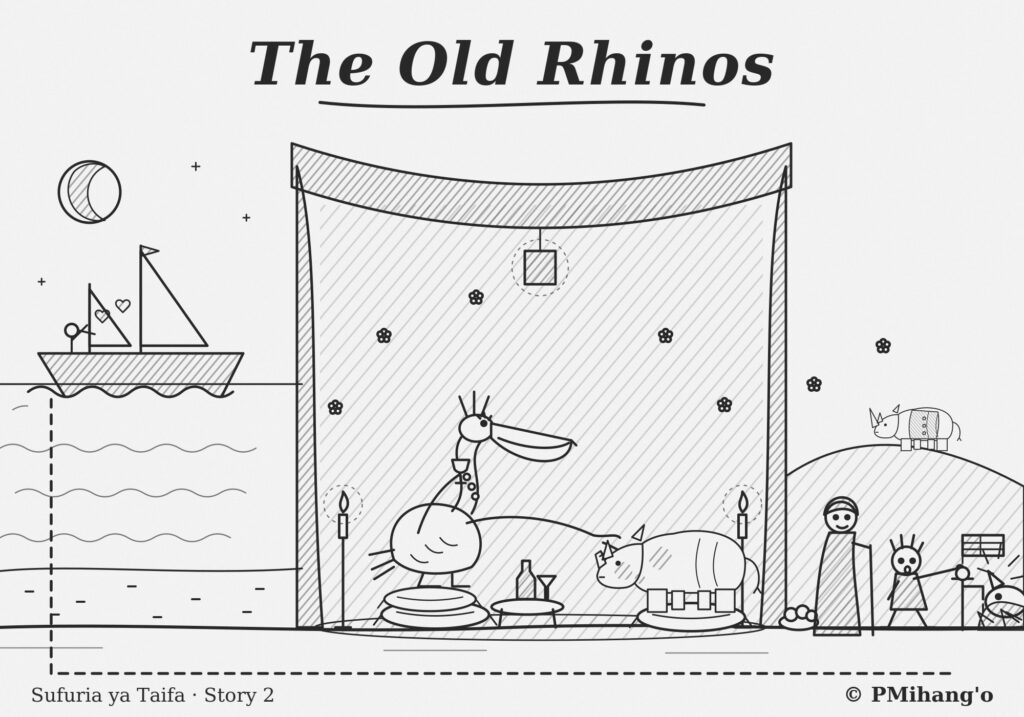
At the centre of it all sat Madam Pelican, in perfumed plumage and pearl beads, with a laugh like a silver spoon dropped into a teacup. She ate first, and she ate slowly. She licked the Ladle clean between courses, and the whole village looked away, embarrassed and a little curious.
Under the pot she laid a pipe. It was a fine, polished pipe, and it ran all the way to a ship in the harbour. In those days it was very well hidden. The villagers believed the pot simply got smaller with age, the way people do.
The Old Rhinos did not like this.
There were seven of them, grey and enormous, with skin like old tractor tyres and eyesight so poor they once charged their own shadow and demanded it surrender. But they had two gifts. They could shout, and they could smell injustice from three hills away.
“This pot is OURS!” roared the eldest, Rhino Mzee Pembe, whose horn had been broken in the Great Argument of the Fence. “Give us back the Ladle!”
They shouted for years. They were chased through the thornbush, put in the Pelicans’ cold cellar and fed on boiled nothing. Wanjiru’s grandmother, Cucu, carried them food in a basket under her tomatoes, and when the guards sniffed it she said, “Only tomatoes, my son,” in a voice so sweet the guards forgave her for everything.
The village sang for the Rhinos, and the songs grew louder every season, until one night Madam Pelican looked at her paperwork, sighed, and said, “Oh, darling. This has become tedious.”
She invited the Rhinos to a private supper.
It was candlelit. There were silk cushions, and there was wine the colour of a blushing sunset. Madam Pelican wore less than usual and smelled of jasmine and old money. The Rhinos, who had spent twenty years in the thornbush, stood in the doorway and stared, which is difficult for a rhino to do gracefully.
“Gentlemen,” she purred, trailing one feather along Rhino Pembe’s thick grey flank, “you have been so brave. So strong. Come, sit. You must be exhausted from all that freedom.”
Rhino Pembe’s thick skin, thick as it was, went pink in patches.
“Madam,” he mumbled, “we are here to discuss the handover.”
“Of course we are.” She poured. “But first, have you ever tried a cushion?”
The negotiation lasted three weeks and was held entirely on those cushions. Somewhere in the second week the Rhinos stopped asking for the pot and began asking about the wine. In the third week they signed a document so long that nobody read the last page, which said, in very small letters, that the Pelicans’ pipe would remain “in a spirit of friendship and mutual benefit.”
Pembe held the pen over it, hesitating.
“It’s only a pipe, darling,” Madam Pelican whispered, close to his ear. “Surely you won’t let a little plumbing come between us.”
He signed. The room exhaled.
The handover was held at dawn, with flags, brass bands and a very long speech. Madam Pelican handed the Ladle to Rhino Pembe with both feathers, and for one moment their hands lingered a second longer than the ceremony required.
“Take good care of her,” she murmured. “She has been very good to me.”
Then she boarded her ship in a cloud of jasmine, blowing kisses, and the whole village wept with joy and also, privately, with a flicker of confusion, because the ship seemed to be riding unusually low in the water.
“FREEDOM!” roared the Rhinos, and the crowd roared back, and the drums began.
For three days the village celebrated. The Rhinos moved into the Pelicans’ old house, because it had the best view of the pot and, as Pembe explained, “it would be wasteful to build another.” They sat on the Pelicans’ cushions, drank the Pelicans’ wine and wore the Pelicans’ tailored coats, which they found surprisingly flattering across the shoulders.
“We must remain humble,” said Rhino Pembe, buttoning his gold waistcoat.
“Humble,” agreed the others, from the sofas.
By the fourth day, the Rhinos had also taken over the Pelicans’ shop and the Pelicans’ fence, and the little round tokens were now stamped with a rhino. The village still carried the wood and the water, but now they did it for their own Rhinos, which the Rhinos explained was completely different.
“The fence protects us from the outside,” said Pembe.
“From whom?” asked a villager.
“Whoever is outside,” said Pembe, and bared his gold waistcoat in a way that closed the subject.
That night, Wanjiru, still young then and carrying her grandmother’s basket, crept out to the pot. She followed the pipe along the grass, past the old Pelican nozzle, and found something curious. The pipe had not been cut, and it had not been removed. Someone had simply fitted a new tap on the end of it, painted in the colours of the new flag.
Behind the tap, in the dark, a pair of grey ears twitched.
“It would be a pity,” whispered Rhino Pembe, appearing quietly beside her, “to waste good plumbing.”
Wanjiru said nothing. She was learning.
In the morning she told Cucu what she had seen. The old woman did not look surprised. She kept shelling beans.
“Child,” she said, “when one man leaves a house and another walks in, the house does not change. Only the snoring does.”
Wanjiru went back to her tomatoes. But she noticed, as the seasons passed, that the Rhinos’ waistcoats kept getting tighter, and that on certain nights, when the wind was right, the whole village smelled faintly of jasmine.