
When the Rhinos had been in charge for a few years, the weather in the village changed.
Nobody could say exactly when. One day there was ordinary Tuesday air, and the next there was a heavy, polite stillness, like a room where someone has just died and everyone is waiting to be told how to feel. The old people called it the Iron Season, because it was the season when everything went quiet and nothing rusted.
It began with a very reasonable announcement.
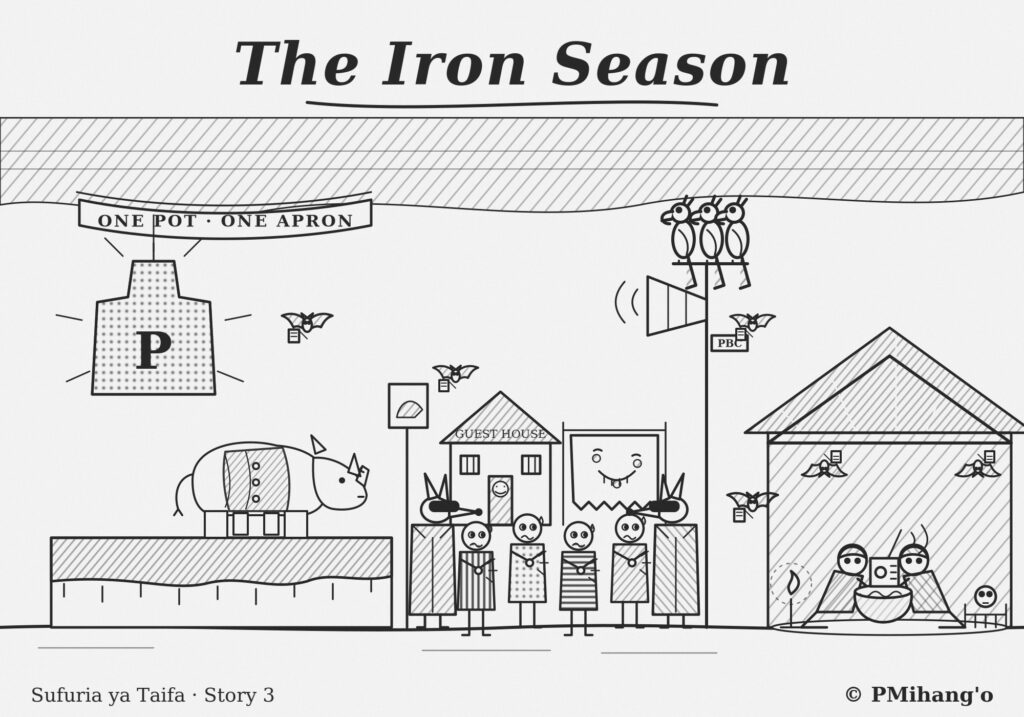
“Dear villagers,” said Rhino Pembe, on a platform draped in gold cloth, “we are a young pot. A fragile pot. And a fragile pot cannot afford four aprons.”
He held up the yellow, the green, the orange and the blue. Each one had been, until recently, somebody’s whole personality.
“Four aprons means four opinions. Four opinions means arguments. Arguments mean instability. So, in the interest of peace, we shall have one apron.”
He held up a fifth apron. It was rhino-grey, enormous, and embroidered in gold with his own initials.
“Now,” he said warmly, “who would like to say anything against this?”
The village looked at the apron. The village looked at the seven Rhinos standing behind him. The village looked at its own feet.
“Wonderful,” said Pembe. “Unanimous.”
The new laws were all simple, and all printed on a very beautiful poster.
The Hush Law: Villagers may say anything they like, so long as it is praise.
The Applause Act: Clapping is voluntary. Not clapping is also voluntary, but is recorded.
The Ministry of Listening: Every wall now has ears. (The bats were hired first, then the gossips, then the neighbours, then, to save money, everyone.)
Rhino Pembe’s portrait was hung in every home, every school and every shop. By the third week he was on the tomatoes too, a tiny stamped face on every skin. Wanjiru, selling them in the market, found that people could not eat a tomato without feeling watched. Sales were excellent.
The Parrot Broadcasting Corporation opened that month. Its news was always the same and always delivered at six: “The pot is full. The Ladle is generous. The Rhino is tired from caring.” The parrots were very good at their jobs. They had been trained to repeat anything, and nothing was ever asked of them beyond that.
The Yellow Hyena, who had once been the loudest voice in the village, stood up at a meeting and said, “Surely, with respect, the pot is not that full.”
The room went still. A bat, near the ceiling, wrote something down.
That evening, two Jackals in dark glasses visited the Hyena and invited him to “rest at the Guest House.” This was the old Pelican cold cellar, repainted a friendly yellow and renamed.
He rested for so long that he never came back. Years later, his widow was given a very handsome rug, “in recognition of his service.”
“It has his laugh in it,” she said to Cucu, stroking the fur. “Isn’t that strange?”
Cucu did not answer. She had learned the first lesson of the Iron Season: in the Iron Season, the safest thing to say is a proverb.
So the village became a place of proverbs.
“A calm sea,” a man would say at the well, “makes a happy fisherman.”
“Indeed,” his neighbour would reply, glancing at the bat, “and a happy fisherman does not ask where the fish went.”
Sentences got shorter. Eyes got longer. People developed a way of pointing with their chins and speaking with their eyebrows. The entire village learned to carry on whole conversations while appearing to say absolutely nothing, and it became so good at this that it forgot how to do anything else.
Weddings were hushed. Funerals were hushed. Even the weeping at funerals was carefully approved, since open grief could be read as criticism of the Ladle’s health policy.
Every evening at six, the whole village gathered under the loudspeaker for the parrots’ news, and when it ended, everyone applauded, loudly and for exactly ninety seconds, watching their neighbours to see who stopped first.
The clapping got louder every year, because the people who clapped loudest were the people most afraid.
Only one house kept a different sound.
Cucu, Wanjiru’s grandmother, had a very old radio, and she hid it in the one place no Jackal would search: in the bottom of her bean pot, under a layer of dry beans, wrapped in a kitenge. At night, with the door bolted and the lamp turned low, she and Wanjiru would lean over the pot and whisper into it.
The radio hissed. Far away, a faint voice from beyond the hills was saying things that the parrots never said: that the Pelicans’ ship had docked on the other coast, and that its hold was full, and that people over there were asking questions about pipes.
“Shh,” said Cucu. “Listen.”
“To what, Cucu? It’s just crackling.”
“Yes,” said Cucu. “But it’s honest crackling.”
One night a Jackal’s shadow passed the window. They froze. Cucu, with the speed of a woman who had survived two governments, dropped a lid on the pot, threw a blanket over the lid and began loudly singing the national anthem, flat, in the wrong key, with her eyes tightly closed.
The Jackal outside paused, listened for a while and moved on, deeply moved.
“It’s the sincerity,” Cucu whispered afterwards, shaking. “They cannot resist it.”
That night, after the lamps were out, Wanjiru crept to the pot to look at the pipe. She found it at the usual place under the grass, and what she noticed was that the pipe was now louder.
Years before, in the noisy days of the aprons, the humming had been faint, drowned out by shouting, singing and arguments. Now there was no argument to cover it. The village had gone so quiet that the pipe could be heard from the market, humming softly and contentedly, as though it were whistling.
She told Cucu.
The old woman set down her beans.
“Child,” she said, “silence is a loan. They tell you it is peace, a gift, but it is a loan. They will let you borrow it for a lifetime, and then one day your grandchildren will be asked to pay it back, with interest.”
“And who collects?”
“Whoever is holding the Ladle at the time,” said Cucu. “And they are always very polite about it.”
Wanjiru went to bed. Her son, still a baby, lay in his cot, wide awake, looking at the ceiling, where the bats hung in rows. He did not cry. In the Iron Season, even the babies had learned not to.
She leaned over him and whispered the one thing she had never been allowed to say aloud.
“One day,” she told him, “you will be very loud.”
On the other side of the wall, a bat rustled and wrote something down.