
It was a mole who found it.
His name was Fuko, he was small and short-sighted, and he had no ambitions beyond a quiet life and a clean tunnel. He worked as night cleaner in the Great Granary, sweeping up grain that spilled from the pipes after the Stork’s midnight deliveries. One evening, while digging a new storeroom for his mother, he put his nose through a wall of soil and found himself under the Great Pot.
There, in the base of the pot, was a hole. It was the size of a wheelbarrow, perfectly round and neatly rimmed in gold, and out of it, in a slow, continuous, shimmering stream, poured the village’s grain. It ran into a pipe, and the pipe ran into a tunnel, and the tunnel ran off into the dark in the direction of a golden roof.
Fuko did what any honest mole would do. He took out his little notebook and wrote down everything he saw, in very small, very careful handwriting.
“Siri ya mtungi aijuaye kata,” says the old proverb. The secret of the pot is known only by the ladle.
Fuko was not the ladle, but he was the next best thing: a witness. He climbed out of his tunnel at dawn, blinking in the light, and walked straight into the market. There he stood on an upturned crate and read his notebook aloud to everyone, including the goats.
“There is a hole in the pot!” he squeaked. “A big hole! It leads to the Stork’s granary! I have measurements!”
The village went very quiet.
Then, all at once, it exploded.
“A hole!” cried a woman, dropping her basket. “In our pot?”
“For years?” cried a man.
“I knew it!” shouted another. “I always said the soup was getting thinner!”
By noon the whole village had gathered at the pot with lamps, sticks and the angry, delighted faces of people who finally have a proper reason to shout. They looked into the hole. They shone lamps down it. A few of the bolder ones even fell in and had to be pulled out, which only made the crowd angrier.
“Where is the Stork?” they roared. “Bring him out!”
The Stork emerged at last, in a black suit, with his head bowed and his wings clasped before him, like a man arriving at his own funeral and slightly enjoying it.
“My people,” he said, in a trembling voice, “I am shocked.”
The crowd paused.
“Shocked and heartbroken. How could such a thing happen under my watch? I trusted my officers. I trusted my cousins. I trusted my plumbers! This hole is a wound in my heart!”
A tear rolled down his beak, and a few of the women in the front row began, awkwardly, to feel sorry for him.
“But fear not,” he continued. “I shall set up a Commission of Inquiry. It will be independent, fearless and thorough, and it will find the truth, wherever it may lead.”
“And who will lead it?” called Njeri from the back.
“The most honest creatures in the land,” said the Stork warmly. “The Tortoises.”
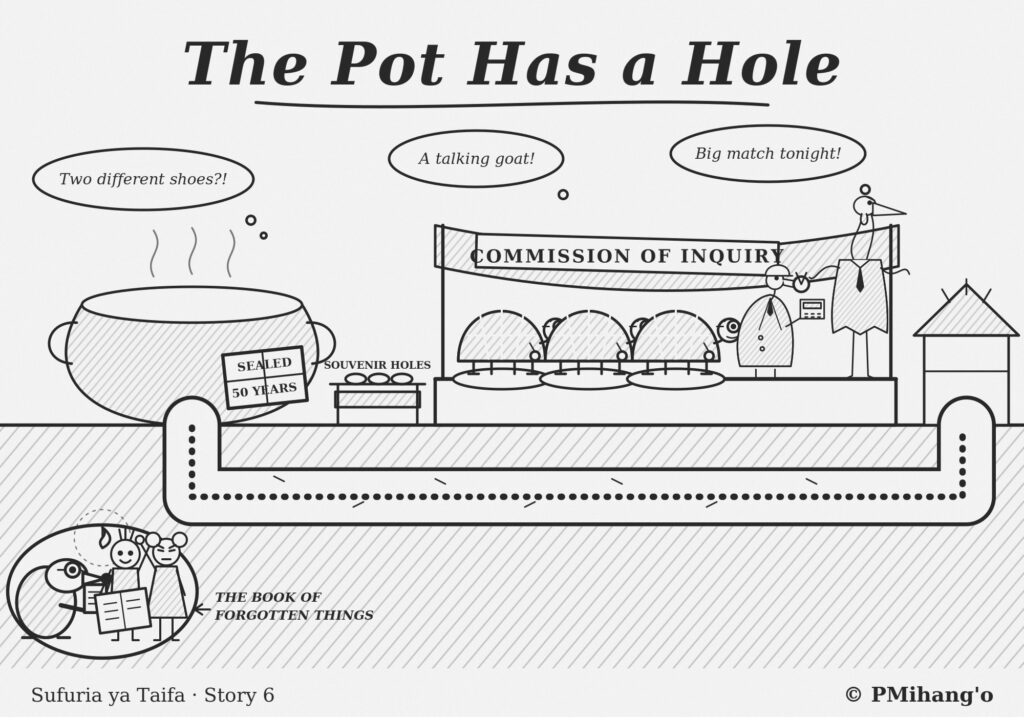
The Commission of Tortoises sat for two years.
They were very old and very slow, and their hearing was poor, so every question had to be asked three times, each time a little louder. They sat under a grand tent on a raised platform, with notebooks, stamps and a great many cushions, and they were fed three meals a day by the Stork’s office, “to ensure their independence.”
Witnesses were called, one by one.
“Did you see the hole?” asked the chief Tortoise.
“Yes,” said Fuko.
“Did you see who dug the hole?”
“Not exactly. But it leads to the Stork’s granary.”
“Many things lead to many places,” said the Tortoise gravely. “A river leads to the sea, but we do not blame the river for the sea.”
“This is a hole!”
“A hole,” said the Tortoise, writing slowly, “that has not been proved to have a motive.”
The Cormorant, Engineer Kanyaga, appeared as a witness in a beautiful suit and a fresh pair of spectacles. He explained that the hole was in fact a drainage feature, “built to protect the pot from excess abundance.” He produced a drawing, a stamp and a smile, and the Tortoises thanked him for his service and awarded him a medal.
On the last day, the Commission’s report was delivered to the village in a very large and beautiful box. The whole crowd gathered in the square, silent and hopeful, as it was carried to the pot in a procession.
The chief Tortoise cleared his throat.
“After two years of careful study,” he read, “this Commission has found that mistakes were made.”
“By whom?” cried a voice.
“Unknown,” said the Tortoise. “Mistakes, as you know, are made by nobody. They simply occur, like weather. We recommend that the report be sealed for fifty years, for the protection of those involved.”
“But who are the ‘those involved’?”
“Also sealed,” said the Tortoise, closing the book with a thud.
And, as the final proof that justice had been done, the Stork stepped forward and promoted the entire Commission. The Tortoises were given houses, and the Cormorant was made Minister of Pipes.
Meanwhile, the village had forgotten.
It happened quietly. In the first year, everyone talked about nothing else. In the second year, the pot was still discussed, though mostly on Sundays. By the third year, a great new scandal erupted: it was discovered that the Stork’s cousin had been seen at a wedding wearing two different shoes, and the village argued about it for months. After that came a football match, a famous singer’s divorce and a rumour about a talking goat, and the hole slowly slid out of everyone’s heads, like a stone dropped into thick porridge.
“Maji yakimwagika hayazoleki,” sighed Cucu. Spilled water cannot be gathered up. “And a village that forgets is a village that keeps spilling.”
Every Friday, the Parrot Broadcasting Corporation reported that the pot was “healthy and thriving.” At the market, someone had started selling little souvenir holes, hand-painted on clay. They were very popular.
And what became of the hole itself?
Well, the Stork, who was nothing if not practical, solved that too. One morning a team of workmen arrived, lifted the great sealed box of the Commission’s report, and, with a respectful nod, used it to plug the hole.
It fitted perfectly.
“Waste not,” said the Stork, patting the box. “The truth is very useful.”
That evening, Fuko the mole sat alone in his tunnel, chewing his pencil. No one had wanted to hear about his notebook any more, and his old job had been quietly given to a nephew of the Cormorant. He might have given up altogether, except for the knock at his door.
It was Njeri and the boy, carrying a lamp and a very large book.
“What’s that?” asked Fuko.
“A new notebook,” said Njeri. She held it up. On the cover, in careful letters, she had written:
THE BOOK OF FORGOTTEN THINGS.
Inside it, in two sets of handwriting, were lists: the pipe, the golden roof, the Pelican’s pipe and the Rhino’s tap, the vanished Hyena, the owl’s evening lessons, the road to the Stork’s gate, the hole in the pot and the box that plugged it. Every one of them had a date.
“People forget,” the boy said, “because nobody writes it down.”
Fuko stared at the book for a long time. Then he took out his own small notebook, opened it to the first page and held it out.
“I have measurements,” he said.
They wrote through the night, by one lamp, in a mole’s tunnel under the village, three people with one pencil among them. And far above them, in the moonlight, the old pot sat quietly, plugged with a report, and for the first time in a very long time, it made no sound at all.