
When Wanjiru’s son was old enough to carry a slate, she sent him to the Great School of Kijiji-cha-Njaa. It stood on the hill, painted a hopeful blue, and the school motto was carved above the gate: Elimu ni Ufunguo. Education is the key.
Nobody ever asked which door the key opened.
The headmaster was Mwalimu Bundi, an owl of tremendous reputation. He wore round spectacles, a gown with three tassels and an expression of permanent disappointment, as though the whole village had failed a test he had set himself. He had studied overseas, at the Pelicans’ school, and had come back with a certificate so long it needed its own cupboard.
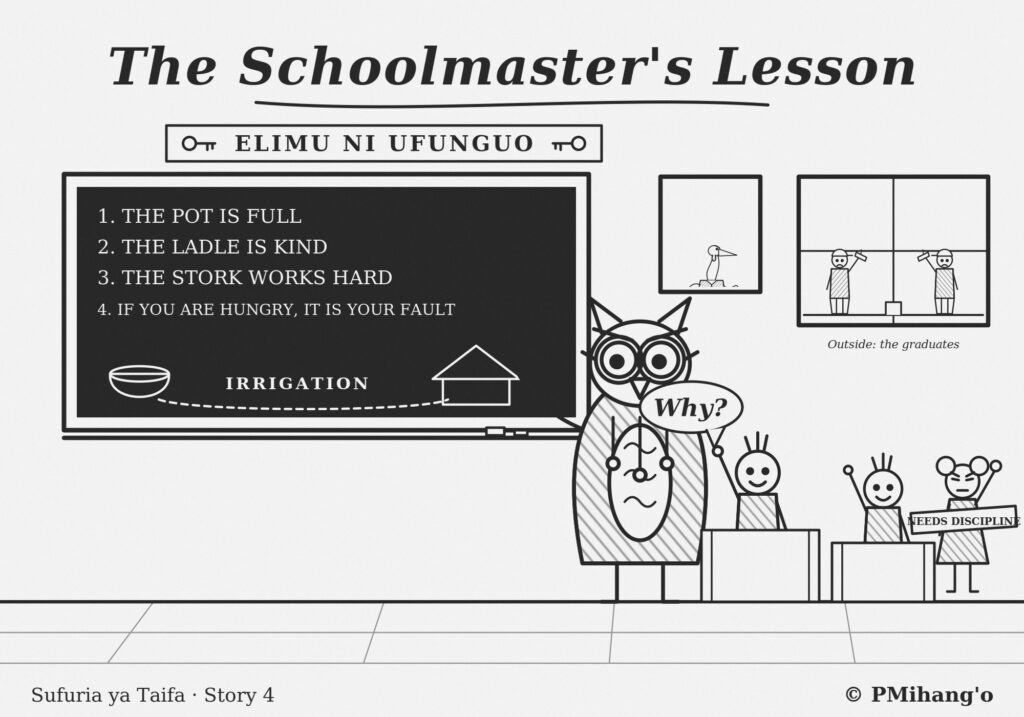
“Children,” he hooted on the first morning, tapping the blackboard, “I shall teach you everything you need to be a success in life. Please sit. Please be quiet. Please do not ask why.”
The new boy raised his hand.
“Why?” he asked.
“Out,” said Mwalimu Bundi.
The curriculum was simple, and the children learned it by heart. It was chanted every morning, in rhythm, with the whole class swaying.
“One: the Pot is full. Two: the Ladle is kind. Three: the Stork works hard. Four: if you are hungry, it is your fault.”
There were other lessons too. In History, the children learned that the village had been founded by the Pelicans “as a kindness.” In Geography, they learned the borders of the Stork’s compound in great detail and the borders of the village not at all. In Mathematics, they were taught that if the Stork has ten loaves and gives you one, he has been generous, and the answer is nine, which is also generous, so no one should check.
In Science, the owl explained that the pot was boiling because the Stork was thinking about it.
The best subject was Civics, which consisted of one lesson, taught every Friday: How to Admire Successful People.
“Look at the Stork,” said Mwalimu Bundi, pointing at a portrait. “Look at his golden granary. Look at his shiny shoes. Is he not clever?”
“Yes, Mwalimu,” chanted the children.
“How did he get so rich?”
“By hustling, Mwalimu!”
“And what is hustling?”
“Taking what you can, Mwalimu, and calling it vision!”
“Excellent. Ten marks each. Chovya chovya humaliza buyu la asali,” he added fondly. Dip by dip you finish the whole gourd of honey. “That is a very old proverb. Very patriotic.”
(It was a proverb about greed. The owl had been reading it upside down for thirty years.)
The examinations were held every term, and they were magnificent.
The questions were always the same, the answers were always the same, and the only skill required was memory. Children who could recite the longest speech about the Stork were called Distinction. Children who asked how the pot got empty were called Troublemakers, and they were sent to the back, where the owl’s assistant, a very tired crow, wrote “NEEDS DISCIPLINE” on their foreheads in chalk.
At the end of the year there was a graduation, with gowns, drums and a very long speech. Each graduate was handed a certificate rolled up in a ribbon, and they all marched out into the village, shining and proud.
There they found that the Pot employed exactly four graduates, and the Stork’s cousins already held three of those jobs.
The rest became Hustlers.
They sold socks at the junction. They sold phone chargers, sunglasses and framed pictures of the Stork. One very gifted graduate sold air, in small bottles, labelled “Freshly Imported.” Their certificates hung on the walls of their stalls, curling in the sun, and they greeted every customer with the same dignified sadness.
“I have a Master’s degree in Pot Administration,” one of them told Wanjiru, handing her three bananas. “But the economy is challenging.”
“Pole sana,” said Wanjiru. Very sorry. “Is the banana also challenging?”
“No,” he said. “The banana is a gift from the Stork’s programme.”
“What programme?”
“I don’t know. But I was taught to be grateful.”
Of all the lessons, the strangest was the one the owl taught in the evening, to the older pupils, behind a closed door.
It was called Leadership.
“A leader,” Mwalimu Bundi told the young students, polishing his spectacles, “must be able to take from the pot without anyone noticing. This takes years of training. First, you must learn to look hungry. Then you must learn to sound sorrowful. Then, and only then, may you be trusted with a pipe.”
He drew a diagram on the blackboard. It was a very familiar pipe, with a golden roof at the end of it.
“This,” he said proudly, “is called irrigation.”
A girl at the back put up her hand. “Mwalimu, where does the water go?”
“To the farm.”
“Which farm?”
“A private one.”
“Whose?”
The owl blinked slowly. “That,” he said, “is not on the syllabus.”
The girl was sent to the back. Her name was Njeri, she was sharper than the pencil she held, and over the years she would remember that room better than any examination.
That night, Wanjiru’s son came home with a gold star, the first of his school life, for reciting the entire four-line chant without a mistake. She hung it above his bed, and he looked at it in silence for a long time.
“Mama,” he said at last, “can I ask something?”
“You can ask me.”
“If the Stork works so hard, why do the hustlers at the junction work harder?”
Wanjiru put down her tomatoes. For a moment she felt very proud and very afraid at the same time, the way you feel when a baby takes its first step towards a cliff.
She sat on the edge of the bed.
“Listen,” she said quietly. “At school, you will learn many things. Learn them well. They will help you pass. But at home, you will learn something else.”
“What?”
“Kuuliza si ujinga,” she said. Asking is not stupidity. “It is the only lesson that was never taught in that school, which is why it is the only one they are afraid of.”
He thought about this, solemnly, with a star above his head.
“Mama?”
“Yes?”
“Can we count the grains again tonight?”
She smiled, and for the first time in many years, the wall behind her did not seem to have ears.