
One morning the Marabou Stork called the whole village to the pot and announced, with a tear in his eye, that he was going to build them a road.
“A great road!” he said. “A road to the sea, to the future, to prosperity! Barabara ya Maendeleo, the Road of Progress!”
The village gasped. Nobody had ever been to the sea, nobody was sure what the future looked like, and the only prosperity they had seen was on the Stork’s own plate. But the word road made them dizzy with joy. A road meant markets, doctors, school buses and tomatoes arriving fresh. They clapped until their palms hurt.
“Who will build it?” shouted someone at the back.
“A very qualified company,” said the Stork, and the curtain behind him fell to reveal a sign painted in gold:
TARMAC & COUSINS (OFFSHORE) LTD.
Founded last Tuesday.
The contractors arrived within the hour, in a convoy of shiny vehicles. They wore hard hats and very soft shoes, and not one of them had ever touched a shovel. The chief engineer was the Stork’s cousin, a fat and charming Cormorant called Engineer Kanyaga, who had a diploma in “Strategic Gravel.”
“How long will the road take?” asked Wanjiru.
“Two years,” said Kanyaga.
“And how much will it cost?”
He took out a calculator the size of a loaf of bread, pressed three buttons and stared at it with great respect.
“Ten thousand sacks of grain,” he said gravely.
“But the whole village only grows eight thousand!”
“Exactly,” said the Cormorant. “That is why we have arranged a loan.”
The loan came from across the sea, from a polite and very patient lender called the Dragon, who lent the Stork a mountain of gold and asked only that it be repaid, with interest, by “whoever happens to be living here later.” The Stork signed in front of the village with a flourish, and the Dragon smiled, because it knew something the village did not: a debt that outlives the person who signed it never has to be collected by the person who signed it.
“Haraka haraka haina baraka,” muttered Cucu from her stool, leaning on her stick. Hurry, hurry has no blessing.
“Cucu,” said Wanjiru, “that is only true when it is the wrong people hurrying.”
The building began with a ceremony, and it was a beautiful one. There were drums, a choir and a ribbon the length of a river, which the Stork cut with a golden pair of scissors while the Parrot Broadcasting Corporation reported it live from six angles.
“This,” said the Stork, wiping his eyes, “is the greatest road in the history of the pot!”
Everyone cheered.
He cut the ribbon again the next week, to open the first kilometre. He cut it a third time to open the second. The ribbon was rolled up each time, carried back to the tent and tied across the path again, and each time it was cut the Stork cried a little more. By the thirteenth cutting the village had begun to admire his stamina.
Meanwhile, the road itself was making slow and mysterious progress.
The first kilometre was perfect, wide and black, with fresh white stripes. The second was narrower, and the third was gravel. By the fourth, the road simply stopped and turned into a footpath, which then turned into a suggestion. On a signboard at the end, in large cheerful letters, was written:
“PROJECT 87% COMPLETE.”
“Eighty-seven percent of what?” Njeri asked.
The Cormorant gave her a warm, patient smile. “Of the budget, my child.”
The bridge was the village’s favourite part.
It was a magnificent bridge, with arches, railings, a plaque and little lamps shaped like lilies. It took eleven months to build, and the Stork called it “a monument to our ambitions.”
The only problem was that it crossed nothing.
“There’s no river,” said Njeri, standing on top with her hands on her hips. “Look. It’s just dry grass.”
“There will be a river,” said the Cormorant.
“When?”
“When we need one.”
He consulted a very official-looking drawing on which a river had been drawn in blue crayon and, beside it, a second, larger bill. A week later, a team of men arrived with spades and began to dig a river under the bridge, and charged for it separately.
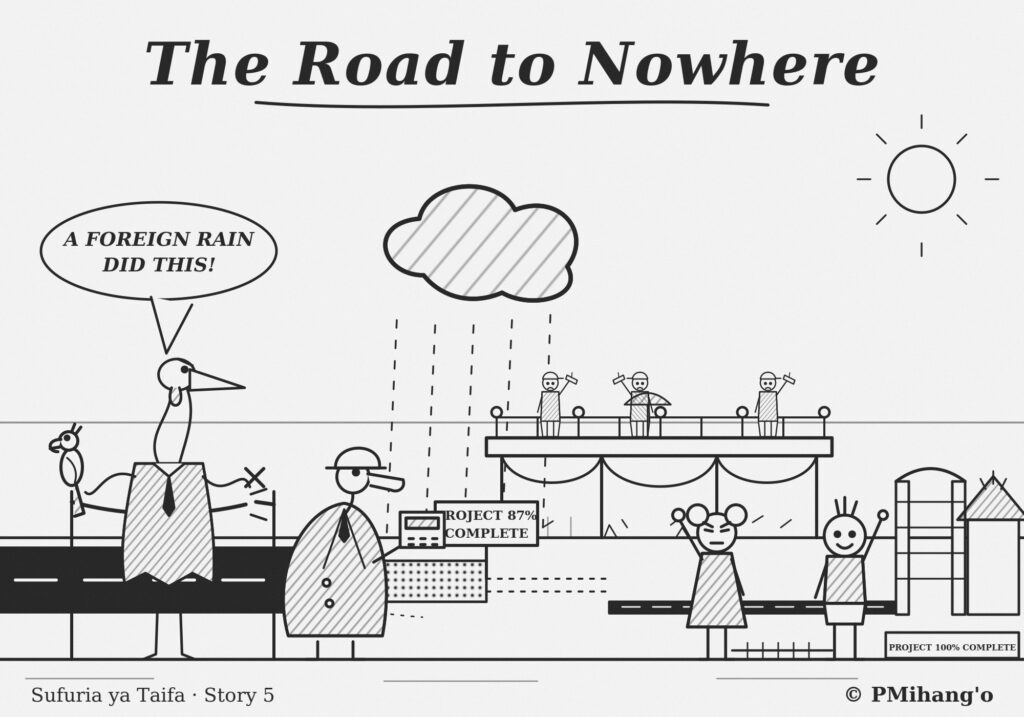
The hustlers from the junction saw their chance at once and set up stalls along the bridge, selling umbrellas, ice-cream and tickets to view the river, which was a ditch. One graduate sold sunscreen, claiming that the road was “so shiny you could get burned from the reflection.”
“Business is good,” he told Wanjiru, handing her a very small bottle. “The economy is finally moving.”
“Where?” she asked.
“Away from here,” he said, and sold the next customer a postcard of the empty river.
In the second year it rained, and the road dissolved.
It went in a single afternoon, with a low gurgling sound, like a man swallowing a very large bowl of soup. The tarmac peeled off in strips, the bridge sank in the new river up to its lilies, and the road to the future turned into a stream carrying away the Stork’s gold-painted signs.
The Stork called an emergency meeting at the pot.
“Dear villagers,” he said gravely, “it is with a heavy heart that I must report that this tragedy was caused by the rain.”
“The rain!” gasped the crowd.
“A foreign rain,” said the Stork, narrowing his eyes. “A rain that does not love this village. A rain that has always envied our progress.”
“Shame!” shouted the villagers, shaking their fists at the clouds.
“But fear not!” he cried. “We shall build the road again, and this time, bigger, stronger and more expensive.”
The Cormorant, standing behind him in a clean new hard hat, nodded and wrote something very large in his notebook.
“Pole pole ndio mwendo,” whispered Cucu. Slowly, slowly is the way to travel. “But not when someone is paying you by the metre.”
That night, Wanjiru’s son and his friend Njeri borrowed a long piece of string and a lamp and walked the whole length of the road.
They measured it in handspans, which took a very long time. When they had finished, they sat down in the mud and did the sums, scratching them in the dirt with a stick.
“The road is twelve kilometres,” said Njeri.
“And the bill,” said the boy, “says it was a hundred and twelve.”
“So where did the other hundred go?”
They looked at each other. Then, together, they looked up. There, a little way beyond the end of the road, where the grass began again, they noticed a freshly poured strip of perfect black tarmac, one metre wide, hidden between the trees. It was smooth, dry and polished, and it ran in a straight, secret line away from the village.
They followed it. It crossed a field, and a stream, and the hill behind the pot, and came at last to a tall, quiet gate. The gate was gold, and behind it, glowing faintly in the moonlight, stood a very large granary with a roof of the same colour.
“The Road of Progress,” whispered Njeri, “goes to the Stork’s house.”
“It’s the only part that was ever finished,” said the boy.
Inside the granary, someone was dancing, a slow, stiff-legged, flapping dance. And on the gatepost, neatly chalked, was a small sign:
“PROJECT 100% COMPLETE.”